
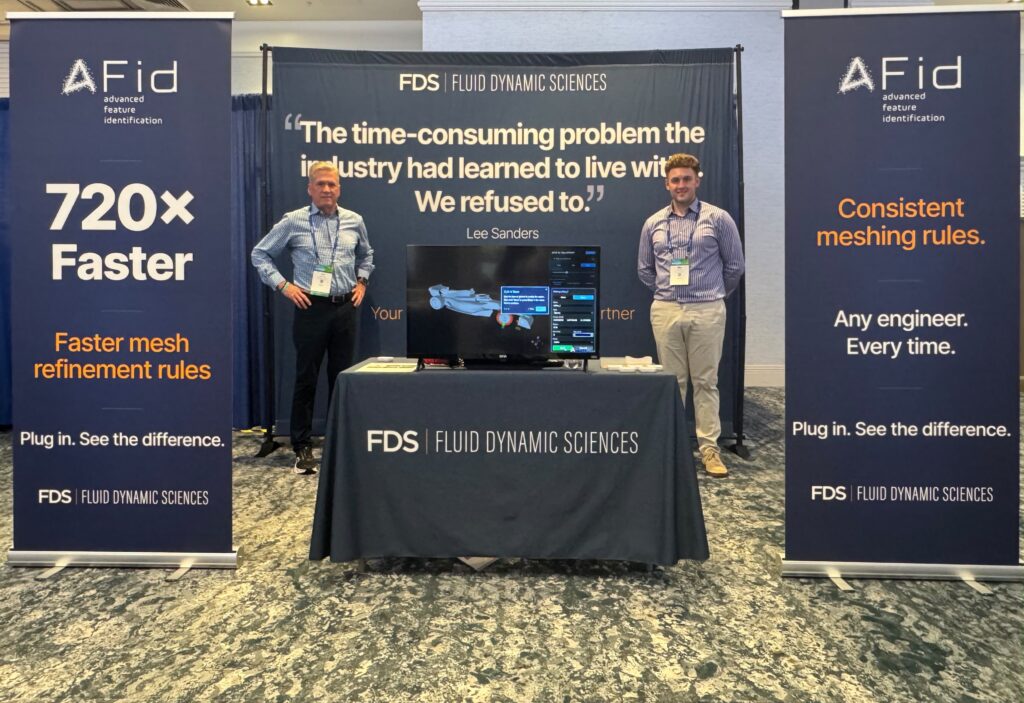
The Fluid Dynamic Sciences team is back from networking and presenting at the AIAA Aviation Forum earlier this month, spreading the word about our new tool, AFid. The forum was the perfect place to talk to engineers about what’s next for the industry and hear first-hand what’s shaping aviation technology right now.
The buzz around AFid was incredible, and the feedback from the aero community was overwhelmingly positive. This is a tool built to tackle one of the most persistent bottlenecks in CFD and simulation work – the hours engineers lose to mesh generation. By automating repetitive, error-prone work, AFid helps teams mesh faster and more consistently, freeing up time for the work that moves an aero engineering project forward.
Lee Sanders, FDS founder, and Max Kopacz, CFD engineer, fielded so many interesting questions at the stand that we decided to round up the top ones here.
1. Is AFid only for mesh rules?
2. How does AFid speed up mesh refinement rules?
The bottleneck is not with the meshing algorithms themselves. In recent years GPU acceleration has made them faster and more robust. The bottleneck occurs at the mesh preprocessing stage. Engineers often spend a disproportionate amount of time cleaning a geometry and ensuring the mesh follows the right rules to solve the physics during the simulation accurately and efficiently.
AFid solves this by enabling engineers to assign meshing rules to a physical region on the geometry and saving them to a library. Once that’s done, any meshing rules can be repeated easily and reliably.
AFid goes through and finds everywhere else that physical region exists in the model, which replaces the time taken clicking through vast, complex geometries and aligning 3D shapes in a Graphical User Interface (GUI) with an algorithm that runs efficiently on a laptop.
The benefits for the aero engineering company go far beyond the desk where simulation is running.
- For the business, that’s faster turnaround on every project and fewer billable hours lost to repetitive prep work.
- For managers, it means consistent, predictable mesh quality across the whole team regardless of who’s doing the work, less time spent firefighting rework after a bad mesh slips through, and the freedom to put skilled people on the problems that actually need them.
- For the CFD engineer, it means spending the day on higher-value work, not stuck clicking through geometry.
3. So does AFid handle mesh generation itself?
No, by design, it does not. It plugs into existing products with the benefit that it does not disrupt mature and validated workflows.
4. How does AFid help with repeatability/consistency?
If two engineers were tasked to mesh the exact same geometry, they would often produce two different meshes. These two meshes may produce different results or even be incompatible with the solver. Unfortunately, seeing these disparities often happens after meshing, or worse, the simulation is already complete, costing compute resources and engineering time.
AFid solves this with a central library, acting as a single source of truth. Rules from that library are applied accurately and repeatedly whenever they show up in anyone’s model. Every engineer will get the same result every time – including the newest members of the team.
5. What is AFid plugged into already?
We are actively implementing AFid across major platforms. Sign up to our newsletter to keep track of our latest announcements.
Want to see AFid in action?
We’ve built our integrations to work with virtually any mesher on the market and would be delighted to work with you too.
If you have a case that would benefit from AFid and would like it integrated into your software, get in touch.